
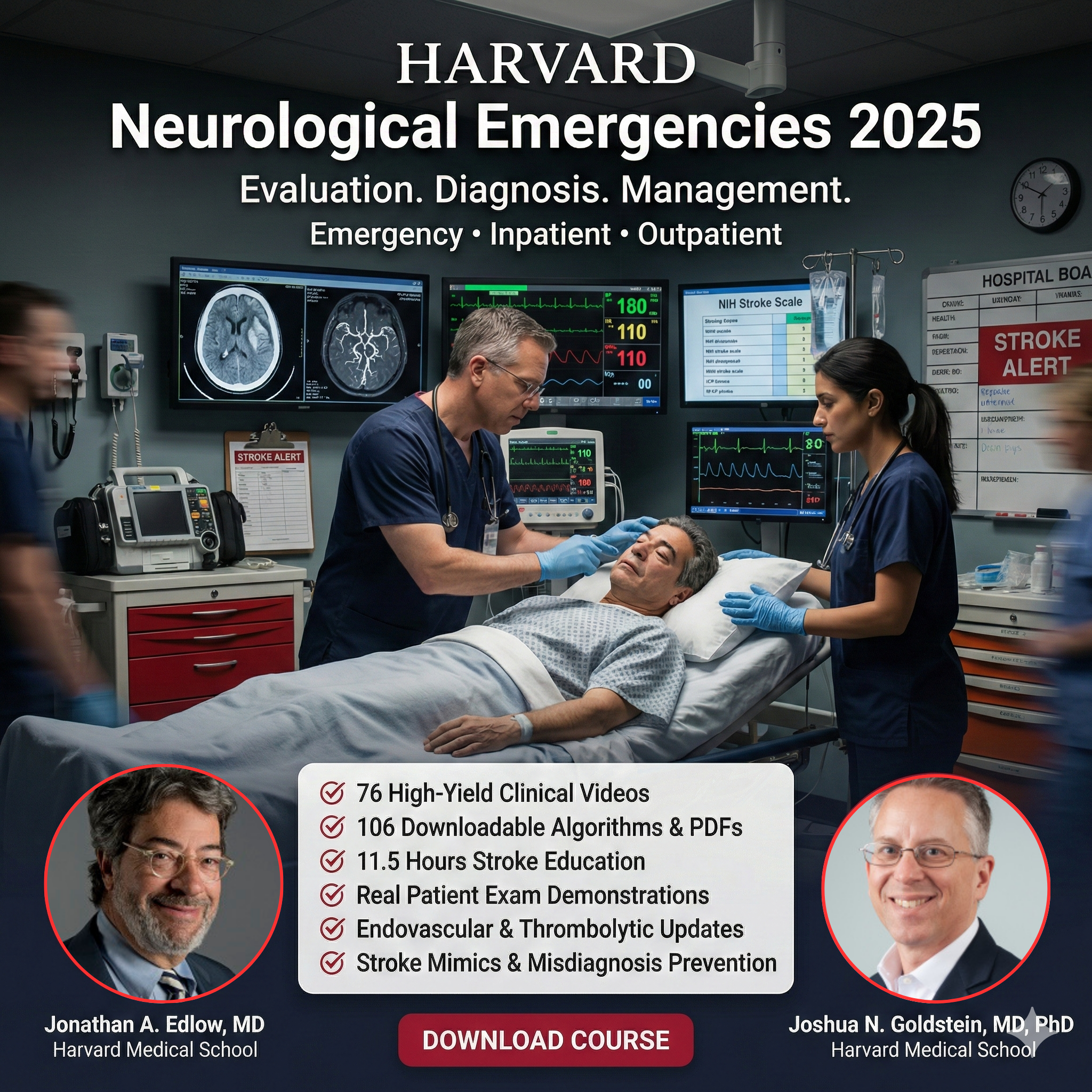
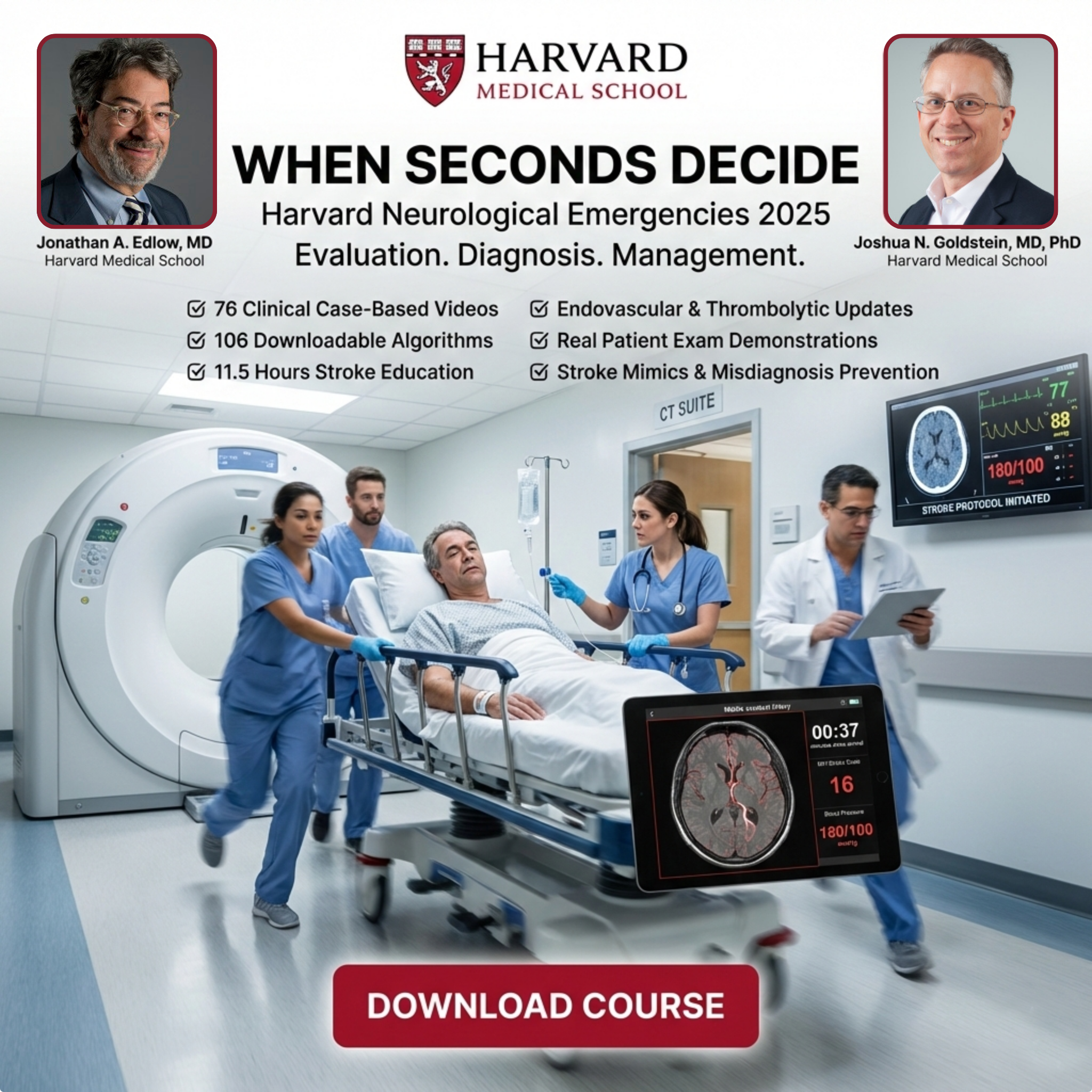
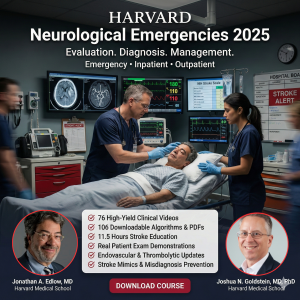

Harvard Neurological
Emergencies 2025
Evaluation. Diagnosis. Management.
In Emergency, Outpatient, and Inpatient Settings.
Complete Digital Library Included
76 Videos • 106 PDFs • 74.69 GB Total Size
Instantly accessible via Google Drive
Neurological Emergencies is an online course, using live streaming, electronic Q&A, and other remote learning technologies.
Strategies, Updates & Best Practices
This special program provides new strategies, updates, best practices, and practical tips to:
- Rapidly identify neurological emergencies
- Act early to optimize patient outcomes
- Optimize your use of diagnostics
- Avoid misdiagnosis
- Evaluate common neurological complaints and high-risk conditions
- Learn practical algorithms to optimize approaches to the history and the physical exam
- Better understand the uses and limitations of neuroimaging tests
- Mitigate risk for you and your patient
- Improve patient safety
- Incorporate updates in practice to ensure state-of-the-art management of high-risk neurological conditions
Highest-Quality Educational Experience
The program delivers the highest-quality educational experience:
-
Teaches practical, effective clinical reasoning and approaches that enable you to deliver state-of-the-art care, given by recognized experts in the field
-
Presents video clips from actual patients that help you see, “firsthand,” hard-to-describe physical exam findings
-
Provides opportunities to interact with faculty and to pose and get answers to your specific questions
-
Delivers the latest information in an engaging manner and clinically usable context so that you have knowledge that you can “take home” and immediately apply to patient care
-
Enables you to tailor your learning experience to your needs, choosing among 18 breakout sessions
Comprehensive Diagnostic & Care Preparation
This course prepares clinicians who work in emergency, inpatient, and outpatient settings to quickly and accurately diagnose and provide appropriate care for patients with:
High-Frequency Symptoms
- Headache
- Back pain
- Dizziness
- Altered mental status
- Weakness
- Seizures
High-Risk Conditions
- Ischemic stroke
- TIA
- Carotid stenosis
- Intracerebral hemorrhage
- Traumatic brain injury
- Cerebral aneurysm
- Spinal cord compression
- Cauda equina syndrome
- Reversible cerebral vasoconstriction syndrome
- Cerebral venous sinus thrombosis
- Cervical artery dissections
- Coma
You Can Customize Your Learning Experience for
Emergency, Outpatient, or Inpatient Care
This program provides education for Physicians, NPs, and PAs in the fields of medicine listed below. You can tailor your learning experience to your needs, choosing among break-out sessions designed for your emergency department, outpatient, and inpatient settings:
Dedicated Q&A time is built into each live streaming session. You can pose your specific questions to clinical leaders in emergency medicine, neurology, neuro-intensive care, stroke neurology, neurosurgery, and neuroradiology.
11.50 Hours of Stroke Education
This program includes 11.50 hours of stroke education, delivering comprehensive updates for state-of-the-art care:
- Ischemic Stroke
- TIA
- Thrombolytics
- Endovascular Therapy
- Carotid Stenosis
- Intracerebral Hemorrhage
2025 Course Highlights
EVALUATION, DETECTION, EARLY ACTION
- Best practices for the workup of common neurological complaints: Headache, Back Pain, Dizziness, Weakness, and Altered Mental Status
- Optimized approaches to the history and the physical exam
- An algorithmic approach to evaluating headaches (what causes you "cannot miss," what tests to do and when to image in order to find them)
- A practical algorithmic approach to back pain; how to spot the history and examination “red flags” for spinal cord and cauda equina compression. Learn when to image, and what to look for!
- Acute weakness—the evidence-based initial evaluation for uncommon but serious causes
- The modern evidence-based evaluation of dizziness (spoiler alert—physical exam beats imaging!)
- Video clips from actual patients that help you see, “firsthand,” hard-to-describe physical exam findings
- How to do a “meaningful neurologic exam” on a patient when numerous other patients are waiting to be seen: what to do and how to prioritize
- The best workup for subarachnoid hemorrhage: have "reports of the death of the lumbar puncture been greatly exaggerated"?
- The best inpatient workup for stroke, including how to treat it and what testing needs to be done urgently
- Best current evaluation of altered mental status and coma
- How to determine when a coma patient is not recoverable or brain dead
- Reversible cerebral vasoconstriction syndrome (RCVS): more common than you think!
- Early actions for patients with severe TBI
DIAGNOSIS
-
Optimize the physical exam:
- How to quickly and accurately diagnose dizziness at the bedside
- What is the significance of a Babinski sign in patients with back pain?
- What findings in a headache patient suggest a specific diagnosis?
-
Optimize how you order imaging:
- When to use CT/CTA/CTP, including what to order and how to interpret results
- When to use MRI, including what to order, when to order, and when NOT to order
- How do I know which headache patients need neuroimaging, and which test should I order? Which blood tests can help and when to order them?
- How to tell if it is a stroke mimic, and if you're not sure, how to proceed with treatment
- Functional neurologic disorders—how to distinguish, how to manage, and how to most effectively communicate to patients
- Back pain: when to order imaging, what to order, and how to interpret results
- When and how to use point-of-care ultrasound to diagnose or treat neurologic complaints
MANAGEMENT of HIGH-RISK NEUROLOGICAL CONDITIONS
- Updates for acute management of spinal cord and cauda equina compression
- Advances in the management of seizures
- State-of-the-art management of cerebral aneurysms and SAH
- Updates in ED and ICU management of TBI
- Management of head injuries
- How to approach pregnant and post-partum women with acute neurological symptoms
- Management of complex headache patients
- Management of coma and delirium
- Updates in anticoagulation reversal for ICH and TBI
- Endovascular stroke treatment: updates, criteria to determine which patients are candidates for it, when to call the interventionalist
- What to do with patients who might have had a TIA (and when to do it)
- Thrombolytics in stroke: updates and criteria to determine who should (and should not) receive this treatment
- What to do when you find a cerebral aneurysm: determining which patients get surgery and who needs follow-up
- Evidence of cauda equina or spinal cord injury: what to do; information needed by spine surgeons; when to call them and criteria to determine who needs surgery
- Updates for intracerebral hemorrhage patients and whether they need blood pressure treatment, anticoagulation reversal, or neurosurgery
- Acute seizures: treatment updates; how to tell if they are nonepileptic seizures; how to manage them in the inpatient (and outpatient) setting; how to choose among all the antiepileptic drugs
- Treating patients with a carotid or vertebral artery dissection
- Patients with minor head injury and concussion: what they need acutely, and what they need in follow-up
- How to use up-to-date evidence to quickly and accurately diagnose dizziness at the bedside
- What to do with patients if you think they have a functional neurologic disorder
- What to do when a patient’s underlying neurologic disorder seems to be getting acutely worse
- What to think about and what to do with patients with acute visual loss
STATE-OF-THE-ART STROKE MANAGEMENT
- Modern stroke management: optimizing IV thrombolytics and endovascular therapy using advanced imaging rather than just the clock
- New criteria to identify stroke patients for endovascular therapy
- Updates in anticoagulation reversal for ICH and TBI
- Treating stroke up to 24 hours after onset
- Treating TIA and intracerebral hemorrhage
- Updates in ischemic stroke, arterial dissections, and reversible cerebral vasoconstriction syndrome
- The right tests to order for potential stroke: when to order CTA, CTP, MRI, MRA, and what is the difference between them?
- Determining if it is a stroke or stroke mimic
- How to avoid missing posterior circulation strokes
CARE OF ELDERLY PATIENTS
- How to ensure the best care for elderly patients who have fallen
- Elderly patients with syncope, delirium, or altered mental status: special considerations for care
- Elderly patients with new headache: is it giant cell arteritis?
- How to determine which patients need further workup for a cause of a fall and which need testing for acute injuries
- Gait disturbance in the elderly
RISK MITIGATION
- Avoiding misdiagnosis
- Mitigating liability
- Medical errors: how to avoid them
- Guidance to address medical errors when they happen
- We all make mistakes—hear how the course directors process their own!
UNIQUE TO THIS PROGRAM
Every year there is a vast amount of practice-changing literature on diagnosis and treatment of patients with neurological emergencies. This program provides important updates including current approaches to the history, the physical, and early management.
As a new or returning participant, you can rely on this program to ensure you are up to date with the latest information and prepared to:
- Better evaluate high-frequency neurological symptoms and high-risk neurological conditions
- Avoid misdiagnosis
- Quickly identify a neurological emergency and act in the first hours to optimize patient outcomes in the emergency, inpatient, and outpatient settings
- Optimize your use of diagnostics
- Incorporate updates in practice to ensure state-of-the-art management of high-risk neurological conditions
The faculty is assembled from the best clinician-educators at Harvard Medical School, Massachusetts General Hospital (MGH), Beth Israel Deaconess Medical Center (BIDMC), and other leading medical centers.
The program is designed to deliver the highest-quality educational experience:
- Teaching practical, effective clinical reasoning and approaches that enable you to deliver state-of-the-art care
- Presenting video clips from actual patients that help participants see, “firsthand,” hard-to-describe physical exam findings
- Allowing time for participants to interact with faculty and to pose and get answers to your specific questions
- Providing the latest information in an engaging manner and clinically usable context so that you have knowledge that you can “take home” and immediately apply to patient care
Course Schedule
October 22 – 24, 2025
Welcome and Introduction
Jonathan A. Edlow, MD, FACEP and Joshua N. Goldstein, MD, PhD
Cerebral Aneurysms: 2025 Update
Christopher S. Ogilvy, MD
Neuroimaging 101
William A. Copen, MD
Back Pain 2025: Red Flags and Beyond
Jonathan A. Edlow, MD, FACEP
Neuroimaging of the Spine: What to Order and How to Read
William A. Copen, MD
Updates in Urgent Management of Spinal Cord and Cauda Equina Disorders
Ganesh Shankar, MD, PhD
Each session includes a 30-minute lecture followed by 15 minutes of live Q&A. Both sessions will be recorded as they are live streamed and will be available for viewing in the course video archive for 60 days.
Neuroimaging in Stroke
William A. Copen, MD
Altered Mental Status: Case Studies
Maura Kennedy, MD and Eyal Y. Kimchi, MD, PhD
Each session includes a 30-minute lecture followed by 15 minutes of live Q&A. Both sessions will be recorded as they are live streamed and will be available for viewing in the course video archive for 60 days.
Acute Pregnancy-Related Neurological Disorders
Andrea G. Edlow, MD, MSc
Gait Disturbance and Falls
Shan W. Liu, MD, SD
Each session includes a 30-minute lecture followed by 15 minutes of live Q&A. Both sessions will be recorded as they are live streamed and will be available for viewing in the course video archive for 60 days.
Intracerebral Hemorrhage
Joshua N. Goldstein, MD, PhD
Recognizing and Managing Complications of Parkinson's Disease
Ludy Shih, MD, MMSc
Functional Neurological Disorders: How to Diagnose and How to Treat
Sara Finkelstein, MD, MSc
Course Faculty
Course Directors
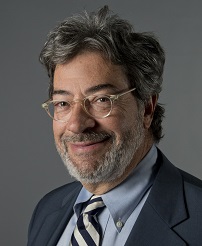
Jonathan A. Edlow, MD, FACEP
Professor of Medicine and Emergency Medicine, Harvard Medical School
Department of Emergency Medicine, Beth Israel Deaconess Medical Center

Joshua N. Goldstein, MD, PhD
Professor of Emergency Medicine, Harvard Medical School
Director, Center for Neurologic Emergencies
Department of Emergency Medicine, Mass General Brigham
Harvard Medical School
Marc A. Bouffard, MD
Assistant Professor of Neurology, Harvard Medical School
William A. Copen, MD
Department of Radiology, Massachusetts General Hospital
Nicole Dubosh, MD
Director of Undergraduate Medical Education, Beth Israel Deaconess Medical Center (BIDMC); Medical Education Fellowship Director, BIDMC; Director of Education Research, Department of Emergency Medicine, BIDMC; Associate Professor of Emergency Medicine, Harvard Medical School
Andrea G. Edlow, MD, MSc
Division of Maternal-Fetal Medicine, Massachusetts General Hospital: Associate Professor of Obstetrics, Gynecology, and Reproductive Biology, Harvard Medical School; Investigator, Vincent Center for Reproductive Biology
Brian L. Edlow, MD
Neurocritical Care Faculty, Massachusetts General Hospital; Co-Director, Mass General Neuroscience; Associate Director, Center for Neurotechnology and Neurorecovery; Affiliated Faculty, Athinoula A. Martinos Center for Biomedical Imaging; Associate Professor of Neurology, Harvard Medical School; Chen Institute MGH Research Scholar 2023-2028
Jonathan A. Edlow, MD, FACEP
Professor of Medicine and Emergency Medicine, Harvard Medical School
Onyinyechi Eke, MD
Director, Global Ultrasound, Massachusetts General Hospital (MGH); Attending Physician, Department of Emergency Medicine, MGH; Assistant Professor of Emergency Medicine, Harvard Medical School
Sara Finkelstein, MD, MSc
Attending Physician and Associate Director, Functional Neurological Disorder Unit, Massachusetts General Hospital; Instructor in Neurology, Harvard Medical School
Joshua N. Goldstein, MD, PhD
Director, Center for Neurologic Emergencies, Department of Emergency Medicine, Mass General Brigham; Professor of Emergency Medicine, Harvard Medical School
Maura Kennedy, MD
Division Chief, Geriatric Emergency Medicine, Massachusetts General Hospital; Associate Professor of Emergency Medicine, Harvard Medical School
Sandeep Kumar, MD
Attending Physician, Department of Neurology, Stroke Division, Beth Israel Deaconess Medical Center; Associate Professor of Neurology, Harvard Medical School
Shan W. Liu, MD, SD
Director, Geriatric Emergency Medicine Division Fellowship; Attending Physician, Department of Emergency Medicine, Massachusetts General Hospital; Associate Professor of Emergency Medicine, Harvard Medical School; Past-President, Academy of Geriatric Emergency Medicine
Rebekah Mannix, MD, MPH
Chief, Division of Emergency Medicine, Boston Children's Hospital; Professor of Pediatrics, Associate Professor of Emergency Medicine, Harvard Medical School
MingMing Ning, MD, MMSc
Director, Cardio-Neurology Clinic; Director, Clinical Proteomics Research Center, Massachusetts General Hospital; Associate Professor of Neurology, Harvard Medical School
Christopher S. Ogilvy, MD
Director, Endovascular and Operative Neurovascular Surgery, Beth Israel Deaconess Medical Center Brain Aneurysm Institute; Professor of Neurosurgery, Harvard Medical School
Ganesh Shankar, MD, PhD
Director of Spine Neurosurgery, Massachusetts General Hospital; Co-Director, Mass General Brigham Neurosurgery Spine Fellowship; Associate Professor of Neurosurgery, Harvard Medical School
Ludy Shih, MD, MMSc
Clinical Director, Parkinson’s Disease and Movement Disorders Center, Department of Neurology, Beth Israel Deaconess Medical Center; Member of the Faculty (appointment pending), Harvard Medical School
Aneesh Singhal, MD
Vice Chair of Neurology & Quality and Safety, Massachusetts General Hospital (MGH); Director, MGH Comprehensive Stroke Center; Co-Chair, Mass General Brigham Stroke Collaborative; Associate Professor of Neurology, Harvard Medical School
Guest Faculty
Rebecca C. Burch, MD
Assistant Professor, Neurological Sciences, University of Vermont Medical Center
Ali Daneshmand, MD, MPH
Assistant Professor of Neurology and Neurosurgery, Boston University School of Medicine
David Greer, MD
Chief, Department of Neurology, Boston Medical Center; Professor and Chair, Department of Neurology, Boston University School of Medicine
Eyal Yaacov Kimchi, MD, PhD
Assistant Professor of Neurology, Feinberg School of Medicine, Northwestern University
Evie Marcolini, MD, FACEP, FCCM
Associate Professor of Emergency Medicine and Neurology, Geisel School of Medicine at Dartmouth; Vice Chair of Faculty Affairs, Department of Emergency Medicine, Geisel School of Medicine at Dartmouth
Thanh Nguyen, MD
Director, Interventional Neuroradiology and Interventional Neurology, Boston Medical Center; Professor of Neurology, Neurosurgery and Radiology, Boston University School of Medicine
Matthew S. Siket, MD, MSc, FACEP
Associate Program Director, UVM Emergency Medicine Residency Program; Associate Professor, Department of Emergency Medicine; Robert Larner M.D. College of Medicine at the University of Vermont
Providing Answers to Common Questions
Participants can rely on this program for answers to frequently asked questions. Below is a small sampling of what we will cover.
THE NEUROLOGICAL EXAMINATION
- How do I do a “full neurologic exam” on a patient when I have 7 other patients waiting to be seen? How do I know what to prioritize?
- What is the current best workup for subarachnoid hemorrhage? Who needs an LP?
- What is the current best inpatient workup for stroke? How do we treat them and what testing needs to be done urgently?
- What is the current workup for coma? How would I know if the patient is not recoverable, or brain dead?
- What is reversible cerebral vasoconstriction syndrome (RCVS) and when should I be looking for this?
DIAGNOSIS / IMAGING
- I’m not a radiologist – what I am looking for on a head CT or MRI?
- When do I really need to order imaging for someone with back pain?
- What kind of back imaging do I need to order, and what am I looking for on it?
- How can I use point-of-care ultrasound to diagnose or treat neurologic complaints?
- How do I know which headache patients need lab tests or neuroimaging? Which tests to get?
- What are the right tests to order for potential stroke? When do I order CTA, CTP, MRI, MRA, and what is the difference between them?
- How can I tell if it is a stroke mimic?
POST-DIAGNOSIS: CLINICAL DECISION-MAKING
- Which patients are candidates for endovascular stroke treatment? When do I call the interventionalist?
- What do I do with patients who might have had a TIA? Do we admit them all? Send them all home?
- What is the current status of thrombolytics in stroke? Whom should we treat (and whom should we NOT treat)?
- What do I do when I find a cerebral aneurysm? Which patients get surgery, who needs follow-up, and what do neurosurgeons do with these patients?
- What do I need to do if I find evidence of cauda equina or spinal cord injury? What information do spine surgeons need when I call them, and what determines who needs surgery?
- What should I do with my intracerebral hemorrhage patients? Who needs blood pressure treatment, anticoagulation reversal? Which patients (if any) need neurosurgery?
- How do I treat acute seizures? How can I tell if they are nonepileptic seizures? How do I manage them in the inpatient (and outpatient) setting? How can I choose among all these antiepileptic drugs?
- How do I treat my patient with a carotid or vertebral artery dissection?
- I see a lot of patients with minor head injury and concussion – what do they need acutely, and what do they need in follow-up?
- What do I do with my patient who has dizziness?
- What do I do with my patient who I think has a functional neurologic disorder?
- What do I do with my pregnant patient with acute neurological symptoms?
- What do I do with the patient with Parkinson's disease who is acutely decompensating?
- What should I be doing early on for my patients with severe TBI?
CARE OF ELDERLY PATIENTS
- I see a lot of elderly patients who have fallen – how can I make sure we are taking the best care of them?
- I see a lot of elderly patients with delirium and altered mental status – what should I be doing with them?
- How do I know which patients need further workup for a cause of their fall, rather than just testing for acute injuries?
- When to think about giant cell arteritis?
RISK MANAGEMENT
- How do I process my own errors and how should the “system" respond to them?
What Past Attendees Are Saying
"This was the most high-yield CME course I've attended in years. The algorithmic approach to back pain completely changed my practice. Finding 'red flags' is so much clearer now."
Dr. Sarah Jenkins
Emergency Medicine
"The stroke management updates were phenomenal. Getting 11.5 hours of dedicated stroke education in one place, especially the endovascular therapy criteria, is invaluable."
James R., PA-C
Hospital Medicine
"Outstanding faculty and incredibly practical tips. The sessions on identifying stroke mimics and conducting rapid, meaningful neurological exams have already helped me in the ED."
Dr. Michael Chen
Neurology
"I appreciated the flexibility of the breakout sessions. Tailoring the learning to outpatient needs made it highly relevant to my daily work. The Google Drive materials are a massive bonus."
Elena M., FNP-BC
Urgent Care
"The video evaluations of real patients presenting with dizziness were a game-changer for my physical exams. Seeing the findings firsthand is so much better than reading about them."
Dr. Robert Hayes
Internal Medicine
"As an ICU attending, the neuroprognostication, TBI early actions, and coma management updates were exactly what I needed. Everything is state-of-the-art and highly actionable."
Dr. Anita Patel
Critical Care
Course Registration & Logistics
Everything you need to know about accessing the course content and materials.
What is included in the digital course materials?
When you register for the course, you receive lifetime access to our massive, comprehensive digital library. This includes:
- 76 High-Quality Videos (Including live streams, lectures, and patient exams)
- 106 Supplementary PDFs (Slides, algorithms, and reference materials)
- Total Size: 74.69 GB of state-of-the-art medical education
All files are conveniently uploaded and organized in Google Drive, making it easy to stream directly or download to your personal devices for offline viewing.
Are the live sessions recorded?
Who should attend this program?
Ready to Advance Your Practice?
Join leading experts and peers to master the evaluation, diagnosis, and management of neurological emergencies.
Reviews
There are no reviews yet.