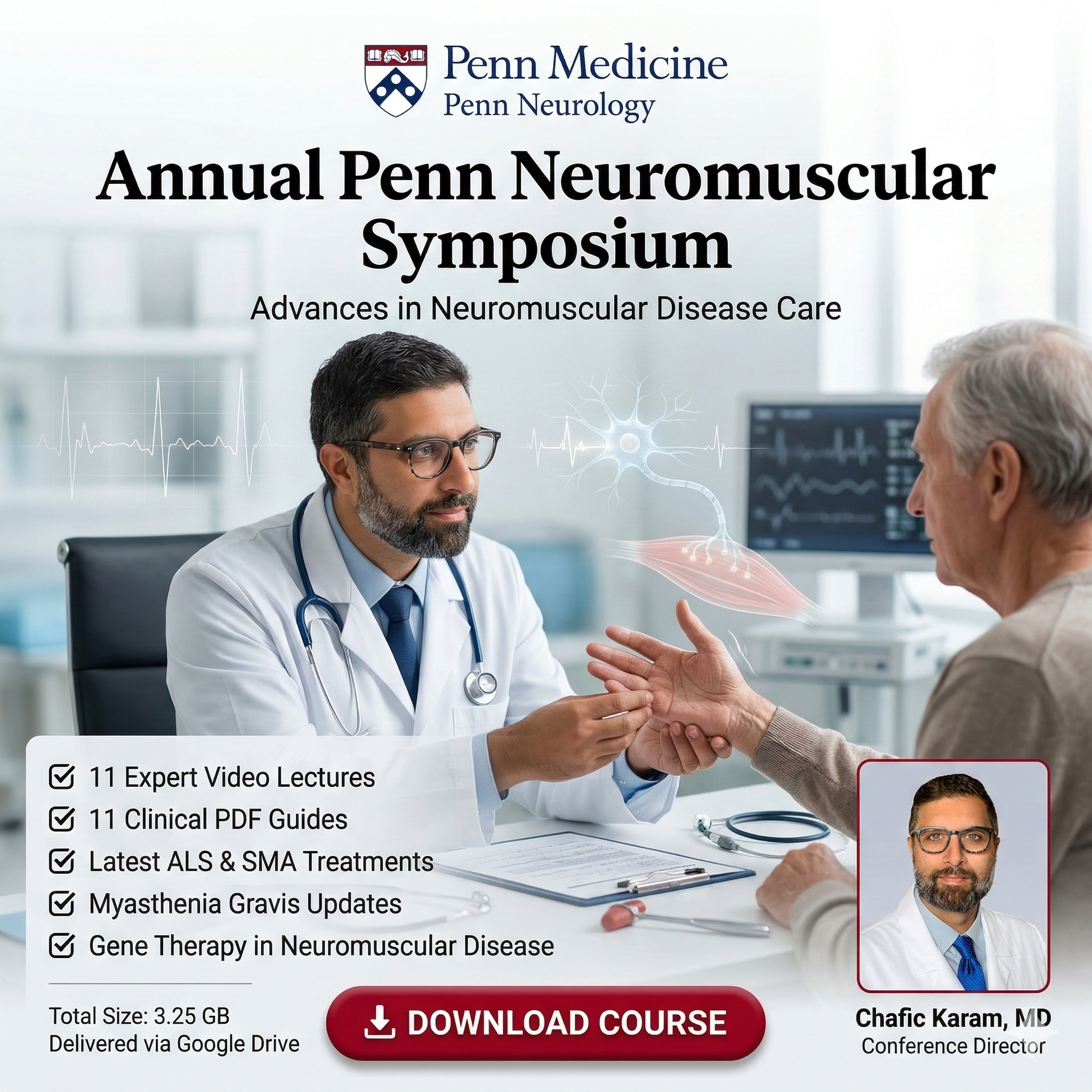
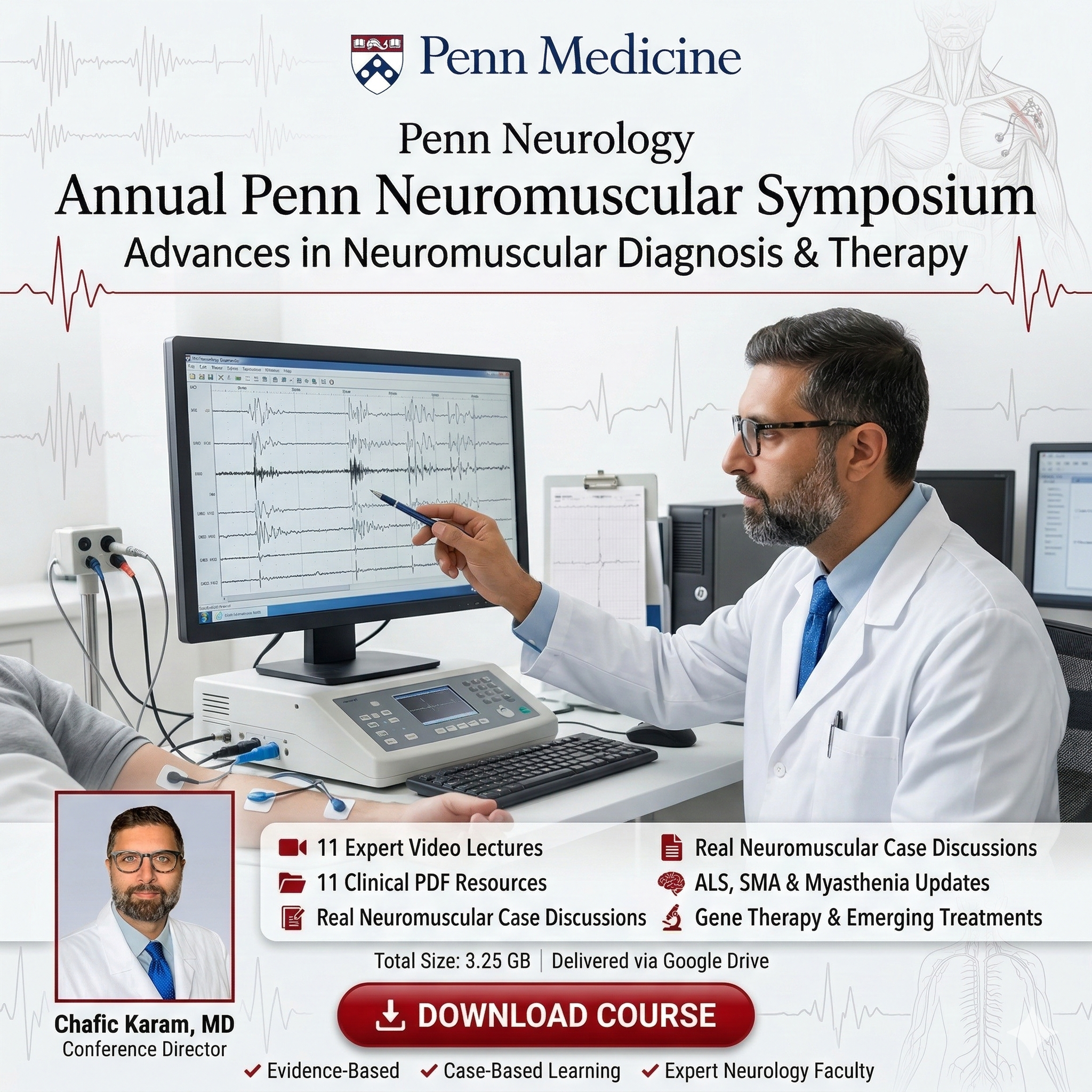
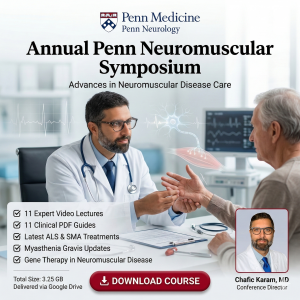

Annual Penn
Neuromuscular Symposium
Exploring available and novel therapies for patients with neuromuscular disorders, from immuno-modulation to gene therapy.
Includes
11 Videos + 11 PDFs
Total Size
3.25 GB
Delivery
Uploaded in Google Drive
About the Symposium
The annual Penn Neuromuscular Symposium explores available and novel therapies for patients with neuromuscular disorders, ranging from immuno-modulation to gene therapy. The interactive course features expert presentations on clinical cases selected from the Penn neuromuscular clinic, highlighting the application of new diagnostic methods and treatments.
Attendees are highly encouraged to participate, exchange experiences, and ask questions. A core goal of the symposium is to enhance collaboration and knowledge exchange among neurologists and other healthcare professionals, ultimately facilitating enrollment in exciting clinical trials at Penn.
Target Audience
This symposium is specifically designed to enhance collaboration and knowledge exchange among:
- Neurologists
- Neuromuscular Specialists
- Fellows and Residents
- Advanced Practice Providers
- Registered Nurses
- Other Healthcare Professionals
Learning Objectives
Upon conclusion of this educational activity, participants will be better able to:
Describe novel treatments for myasthenia gravis, including emerging therapies and their mechanisms of action.
Discuss new diagnostic approaches and treatment strategies for neuropathy associated with amyloidosis.
Discuss the different types of demyelinating neuropathies and outline current approaches to their diagnosis and management.
Describe novel treatments for SMA and ALS, including recently approved therapies and emerging clinical trial data.
Describe current approaches to the diagnosis and treatment of pulmonary complications in neuromuscular diseases.
Apply antibody testing in the diagnosis of inflammatory myopathies and describe novel therapies under investigation.
Discuss the role and recent advances of gene therapy in the treatment of hereditary myopathies.
Discuss challenging clinical cases to enhance diagnostic reasoning and management strategies in neuromuscular disorders.
Discuss recent advances in the diagnosis and treatment of hereditary neuropathies.
Symposium Agenda
Leadership & Faculty
Conference Director
Chafic Karam, MD
Professor of Clinical Neurology; Chief, Neuromuscular Division
Medical Director, Neuromuscular Fellowship Program
Penn Medicine, Philadelphia, PA
Distinguished Speakers & Faculty
Shawn Bird, MD
Professor of Neurology
Medical Director, Electromyography Laboratory at HUP
Penn Medicine
David R. Cornblath, MD
Professor Emeritus, Neurology
Johns Hopkins University School of Medicine
Lauren Elman, MD
Professor of Neurology
Director, MDA Clinic; Director, Penn Comprehensive ALS Center
Penn Medicine
Matthew B. Harms, MD
Associate Professor of Neurology
Columbia University Irving School of Medicine
Rebecca Hsu, MD
Assistant Professor of Clinical Neurology
Penn Medicine
Paul Mcintosh, MD
Assistant Professor of Neurology
Penn Medicine
Steven S. Scherer, MD, PhD
Emeritus Professor of Neurology
Penn Medicine
Marcus V.R. Pinto, MD, MS
Neuromuscular Disease Specialist
Mayo Clinic
Rami Massie, MD
Guest Faculty
Michelle Kaku, MD
Guest Faculty
Michael Baer, MD
Guest Faculty
A. Gordon Smith, MD
Arthur Asbury Endowment Lecturer
Colin Quinn, MD
Guest Faculty
Naomi Amudala, CRNP RN
Guest Faculty
Nasheed Hossain, MD
Guest Faculty
Case Presenters
Tyler Crissinger, MD
Neuromuscular Fellow, Penn Medicine
Eduardo Perez, MD
Neuromuscular Fellow, Penn Medicine
Attendee Reviews
Hear what past participants have to say about the Annual Penn Neuromuscular Symposium.
"An incredibly insightful symposium. The case presentations were directly applicable to my clinical practice. I appreciated the deep dive into demyelinating neuropathies."
Dr. Sarah Jenkins
Neurologist
"The updates on gene therapy and SMA treatments were exactly what our team needed. Highly recommend this event for any neuromuscular specialist or fellow."
Mark Torres
Advanced Practice Provider
"Excellent networking opportunities and the faculty are top-notch. The interactive environment allows for real-time problem solving and clinical exchange."
Dr. Emily Chen
Neuromuscular Fellow
Reviews
There are no reviews yet.